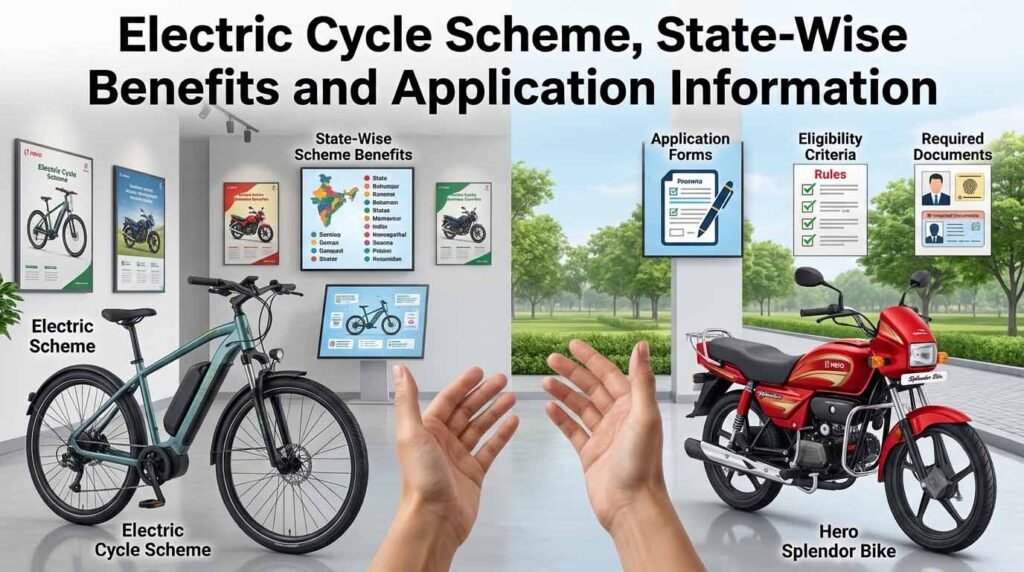
Electric cycles are becoming an increasingly popular transportation option in India because they offer an affordable, convenient and environmentally friendly way to travel. They use rechargeable batteries and electric motors to provide assistance while riding, helping people travel without depending entirely on traditional fuel-powered vehicles.
The Electric Cycle Scheme is a term commonly used for government initiatives, subsidies and financial assistance programs designed to encourage electric mobility. Different state governments may introduce their own electric vehicle policies, incentives or special programs for students, workers and other eligible residents.
However, it is important to understand that there is no single nationwide scheme guaranteeing a free electric cycle to every citizen. Benefits, eligibility requirements and application procedures depend on the particular state policy and any officially announced program.
This article explains the possible benefits, state-wise policy differences, eligibility conditions, required documents and application information.
Objectives of the Electric Cycle Scheme
The main objective of electric mobility initiatives is to encourage people to choose cleaner transportation alternatives. Electric cycles can help reduce dependence on petrol-powered vehicles, particularly for short-distance journeys.
Some important objectives include:
- Encouraging environmentally friendly transportation.
- Supporting affordable daily commuting.
- Promoting electric mobility in urban and rural areas.
- Reducing dependence on conventional fuel.
- Encouraging the adoption of energy-efficient vehicles.
- Supporting students and working individuals where targeted assistance is available.
Government incentives may also help increase awareness about electric transportation and improve the availability of electric mobility products.
Major Benefits of Electric Cycles
Electric cycles offer several practical benefits for everyday transportation. Depending on the model, battery capacity and riding conditions, users can receive different levels of electric assistance.
1. Affordable Transportation: Electric cycles generally cost less to operate than petrol-powered two-wheelers because they do not require petrol.
2. Battery-Powered Assistance: An electric motor can assist the rider while pedalling, making certain journeys more convenient.
3. Environment-Friendly Mobility: Electric cycles produce no exhaust emissions during operation.
4. Convenient Daily Travel: They can be useful for short journeys, including commuting to educational institutions, workplaces and nearby markets.
5. Lower Running Expenses: Electricity costs for charging can be relatively low, although battery replacement and maintenance expenses should also be considered.
6. Easy Parking: Their compact size makes electric cycles convenient to park in many locations.
State-Wise Electric Cycle Scheme and Benefits
Electric vehicle incentives are not identical across India. Some states have introduced electric vehicle policies, while others may offer separate support through specific departments or targeted programs. The following state-wise overview explains the policy situation that applicants should investigate.
1. Uttar Pradesh
Uttar Pradesh has an Electric Vehicle Manufacturing and Mobility Policy introduced in 2022. The state provides purchase incentives for eligible electric vehicles through its official subsidy portal. However, the listed two-wheeler incentives should not automatically be considered applicable to every electric cycle. Applicants must check the vehicle category and current eligibility conditions.
Official application information: UP EV Subsidy Portal.
2. Maharashtra
Maharashtra has introduced electric vehicle policies to encourage the adoption of cleaner transportation. Buyers should check the latest state policy to understand which electric vehicle categories qualify for financial incentives. Separate student bicycle assistance, where available, may have different eligibility requirements.
3. Gujarat
Gujarat has previously operated bicycle assistance initiatives for students. Such programs have generally been connected with educational support rather than a universal free electric cycle benefit. Applicants should verify whether any current scheme specifically covers electric bicycles.
4. Madhya Pradesh
Madhya Pradesh has developed an electric vehicle policy framework that also discusses electric cycles. Its 2025 policy document mentions designated electric-cycle parking facilities and incentives related to parking. Applicants should verify the final notified provisions before assuming that a purchase subsidy is available.
5. Karnataka
Karnataka has an electric vehicle policy focused on encouraging electric mobility and supporting the EV industry. Residents should check current government notifications for available purchase incentives and whether electric cycles are included.
6. Tamil Nadu
Tamil Nadu has introduced policies to promote electric vehicle manufacturing and adoption. The state has also focused on developing its electric mobility ecosystem. However, electric-cycle buyers should confirm whether a specific consumer subsidy is available before purchasing.
7. Delhi
Delhi has introduced electric vehicle initiatives to encourage cleaner transportation and reduce vehicle emissions. Its EV policy framework includes incentives for selected vehicle categories. The availability of electric-cycle-specific assistance must be checked separately through official government announcements.
8. Rajasthan
Rajasthan has taken steps to promote electric vehicle adoption through its state-level policies. Residents should check the latest transport department notifications for applicable benefits, vehicle categories and application conditions.
9. Kerala
Kerala has encouraged electric mobility through policy initiatives and supporting infrastructure. Interested residents should verify current incentives through the state’s official transport and government portals.
10. Other Indian States
States such as Bihar, Haryana, Punjab, Odisha, Assam, Telangana, Andhra Pradesh, Jharkhand, Chhattisgarh and Uttarakhand may have different electric mobility policies and student assistance programs.
The availability of financial assistance depends on the particular scheme, its funding, the vehicle category and the application period. A benefit available in one state should not be assumed to apply in another.
Important: The state-wise information above describes policy initiatives and areas to investigate, not a guarantee of an active free electric-cycle scheme in every state. The State Policy Matrix provides a useful comparison of state electric vehicle incentives.
Eligibility Criteria for Electric Cycle Assistance
Eligibility conditions depend on the government department and the particular program. Some possible requirements under targeted assistance schemes include:
- The applicant must be a resident of the state where the scheme operates.
- The applicant must satisfy the prescribed age requirements.
- Students may need to provide proof of enrollment in an eligible educational institution.
- Applicants must provide valid identity and residential documents.
- The electric cycle must meet the technical specifications mentioned in the scheme.
- The applicant must follow the prescribed income criteria, if applicable.
- Applicants must not claim duplicate benefits where the scheme prohibits them.
Not every electric vehicle policy has all these conditions. The official notification should always be treated as the final source of eligibility information.
Documents Required for Application
Applicants may need to arrange the following documents when applying for an electric cycle assistance program:
- Aadhaar card or another accepted identity document.
- Residential address proof.
- Recent passport-size photograph.
- Mobile number for application updates.
- Bank account details, where financial assistance is provided.
- Student identity card or educational certificate, if required.
- Income certificate, where applicable.
- Purchase invoice, if the program provides reimbursement.
- Vehicle details and manufacturer information, where required.
Applicants should submit only the documents specifically requested by the relevant government department.
How to Apply for the Electric Cycle Scheme Online
If a state government announces an electric-cycle assistance program, the application process may involve the following steps:
Step 1: Visit the Official Website
Open the official state government or concerned department website. Look for the electric cycle scheme or electric vehicle assistance notification.
Step 2: Read the Scheme Guidelines
Check the eligibility conditions, application dates, benefits, vehicle specifications and required documents.
Step 3: Complete Registration
If online registration is available, enter the requested personal information and create an application account.
Step 4: Fill Out the Application Form
Provide the required details carefully, including your name, address, age and other information requested by the department.
Step 5: Upload Required Documents
Upload clear copies of the required certificates and supporting documents in the prescribed format.
Step 6: Submit the Application
Review the information before submitting the form. Save the application reference number for future use.
Step 7: Check Application Status
Use the official portal or contact the concerned department to check the progress of your application.
Some programs may require offline applications through schools, colleges, local offices or designated government departments instead of online registration.
Electric Cycle Subsidy and Financial Assistance
Financial assistance can vary according to the state policy, vehicle category and available government budget. Some policies offer purchase subsidies for eligible electric two-wheelers, while others focus on tax exemptions, registration benefits or charging infrastructure.
For example, Uttar Pradesh has an official EV subsidy portal that explains its purchase incentive process for eligible electric vehicles. The policy provides for individual buyers to receive a qualifying benefit subject to applicable conditions. However, applicants must confirm that their particular electric cycle falls within an eligible vehicle category before applying.
There may also be programs that provide bicycles or other educational assistance to students. These should not be confused with electric-cycle purchase subsidies.
How to Check the Application Status
After submitting an application, applicants should keep their reference number and registered mobile number available.
The general status-checking process is:
- Visit the official scheme portal.
- Find the Application Status section.
- Enter the application number or other requested details.
- Complete any verification process.
- Review the application status displayed on the screen.
If the application is pending or rejected, contact the concerned department to understand the reason and available correction process.
Important Things to Check Before Applying
Before purchasing an electric cycle or submitting an application, applicants should consider a few important points:
- Confirm that the scheme is officially announced by the state government.
- Check whether electric cycles are included in the eligible vehicle category.
- Verify the last date for applications.
- Purchase only a vehicle that meets the prescribed technical standards.
- Check whether assistance is provided before purchase or through reimbursement.
- Avoid websites promising guaranteed free electric cycles without an official notification.
Never share OTPs, banking passwords or sensitive personal information on unknown websites claiming to provide government benefits.
Government Websites for Scheme Information
The following websites can help applicants find authentic information about electric mobility policies and government assistance.
| Website | Purpose |
|---|---|
| National Portal of India | Government scheme information |
| Ministry of Road Transport | Transport policies |
| UP EV Subsidy Portal | Uttar Pradesh EV incentives |
| Ministry of Heavy Industries | Electric mobility initiatives |
Conclusion
The Electric Cycle Scheme is an important topic for people interested in affordable and environmentally friendly transportation. Different Indian states have introduced electric vehicle policies and various forms of student or consumer assistance. However, the availability of a free electric cycle or direct purchase subsidy depends on the specific government program.
Applicants should carefully check their state’s official notifications, eligibility conditions, required documents and application procedures before making any purchase or submitting personal information. By using verified government websites and understanding the applicable rules, interested residents can avoid misleading claims and make informed decisions about electric-cycle assistance programs.